



Laurence is a copywriter and trained journalist. His passion is creating insightful and educational content for dental professionals of every level. Outside of work, he enjoys watching sport, quizzing and spending time with his family.
What is Addition Silicone?
Addition silicone, often shortened to “a-silicone”, is the most used impression material in restorative dentistry. It is widely regarded as the best impression material due to the advantages it holds over alternative materials. Also known as PVS (polyvinyl siloxane) or VPS (vinyl polysiloxane), addition silicone is an elastomeric impression material typically used for creating crowns, bridges, partial dentures and implants. A-silicone can take several different forms but will always follow the same chemical reaction of polymerisation and be presented as either a one-stage or two-stage paste-to-paste system.
Addition Silicone Composition
A-silicone Base Paste:
- Polymethylhydrosiloxane (PMHS)
undergoes cross-linking - Fillers (colloidal silica)
controls viscosity
A-silicone Accelerator:
- Polyvinyl siloxane cross-linking agent
- Platinum salt catalyst
- Fillers controls viscosity
What Are the Different Types of A-Silicone?
There are a few different types of addition silicone. These are based on their differing amounts of filler content. Filler content dictates the flow properties (viscosity) of each. The more filler, the thicker and less flowable the material will be.
Addition silicone materials come in as many five viscosities. Starting from the lowest viscosity to the highest, these are extra light body, light body, medium body (universal), heavy body and putty. The most used are medium body (35%-75% viscosity), heavy body (60%-70% viscosity) and light body (5%-15% viscosity), commonly referred to as wash.
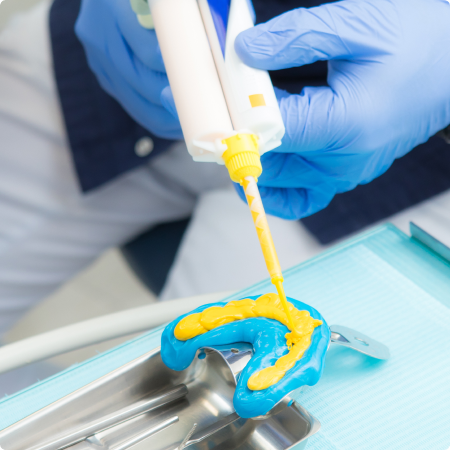
Different types of addition silicones come with different setting (polymerisation) times. Addition silicones can be presented in double-barreled cartridges for use in an automix gun or as a base and catalyst putty.
How is A-Silicone Used?
An a-silicone impression can be done using either a one-stage or two-stage paste-to-paste technique.
- One-stage impression: Heavy-bodied a-silicone or putty is placed onto an impression tray. A layer of light-bodied a-silicone (wash) is then placed over it or directly onto the relevant teeth or both. The impression tray is then placed back into the patient’s mouth for the material to set.
- Two-stage impression: A putty impression is recorded first, and after it has set it is relined with a thin layer of wash material. Two-stage impressions can be taken with or without a spacer.
Advantages of A-Silicone
Most Dimensionally Stable Impression Material
Addition Silicone creates no by-products when it sets. This is what makes it the most dimensionally stable impression material on the market. Also, because there is no shrinkage dental technicians can pour more than one model from one cast.
In comparison, condensation silicone produces an alcohol by-product that can cause the impression to shrink and alginate is susceptible to both imbibition (swelling) and syneresis (shrinking).
Best Fine Detail
Addition silicones provide very precise impressions with the best fine detail of any material.
This makes it the ideal choice for final impressions and ensuring the end product fits perfectly in the mouth of the patient.
Most Time to Pour
An a-silicone impression can be poured with gypsum as long as 60 minutes after setting. Its excellent stability means the impression could probably keep its shape for days before it needed pouring.
By comparison, alginate impressions should be poured with gypsum within 10 minutes and condensation silicone (c-silicone) within 30 minutes.
High Patient Acceptance
Addition silicone does not have an unpleasant taste or smell.
It also has a very short setting time, as quick as 2 minutes 30 seconds for fast-set varieties. This means the impression tray does not have to stay as long in the patient’s mouth.
Disadvantages of A-Silicone
- Cost
- Inhibited by the sulphur in latex gloves and rubber dam, so non-latex gloves and dams should be used if necessary
- Hydrophobic so requires excellent moisture control
Kent Express’ bestselling a-silicones
Cyber Silicone Putty Soft Fast 800g/500ml
Impression material based on Vinyl polysiloxane. Excellent detailed reproduction. High tear strength. Hydrophillic. Total working time 2 minutes including 30 second mixing time. Total setting time 4 minutes.
Cyber Silicone Putty Soft Regular 800g/500ml
Impression material based on Vinyl polysiloxane. Excellent detailed reproduction. High tear strength. Hydrophillic. Total working time 2 minutes including 30 second mixing time. Total setting time 5 minutes 30 seconds.
Share


You May Also Like
;)
Enhance Your Restorations
Discover how 3M's impression materials, composites and polishing discs can optimise your restorations from start to finish.

;)
Retraction Cord Vs Paste
A look at the pros and cons of the two most popular gingival retraction methods for impression taking prep
;)
Avoid Voids in Impressions
Advice on the best techniques and materials to use to avoid those dreaded impression voids.
;)
Silicone Impression Materials
An in-depth look at the similarities and key differences between the two main silicone impression materials
;)
Cyber Silicone Impression
Two of Kent Express’ current most popular silicone impression systems are Cyber Silicone from Cybertech and Honigum from DMG.
;)
3M Prep to Cem
Several considerations must be made for securing an indirect restoration to tooth structure can sometimes complex. This guide aims to provide solutions.
;)
Alginate Impression Material
Everything you need to know to find the best dental alginate impression material for your practice.
;)
Impregum Impression Material
3m Impregum Penta has been our number one selling polyether impression material for a number of years. Find out more about its advantages.
;)
Dental Extraction Products
Should you let patients take their extracted teeth home? Find out the benefits and risks with Kent Express' helpful guide. Shop now for dental extraction products.
;)
Cognitive Decline
Adults who experience tooth loss are more likely to suffer from cognitive impairment and dementia, a new study has found.